
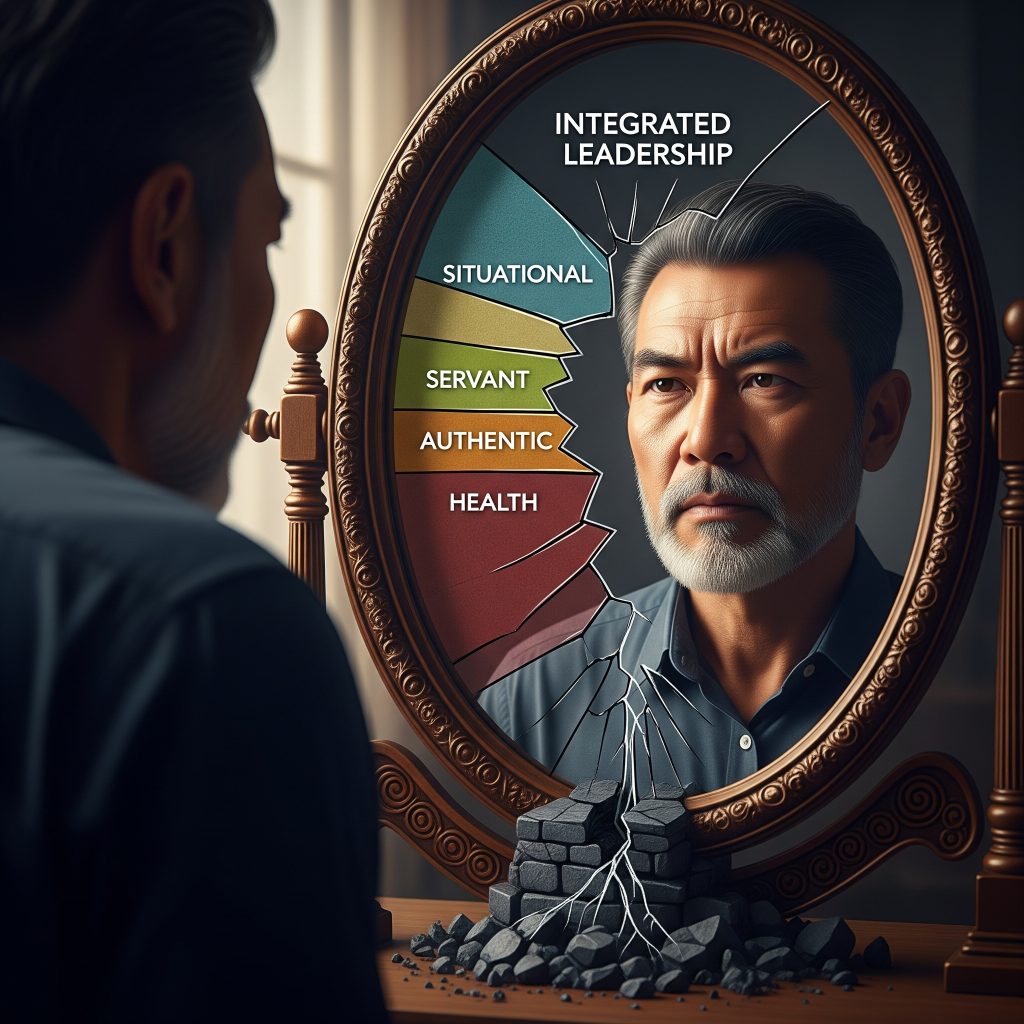
We’ve explored the Integrated Leadership model as a map for growth and a tool for navigating crises. But perhaps its most powerful application is as a mirror for self-reflection after we’ve made a mistake. Leadership isn’t about being perfect; it’s about having the tools to understand our imperfections and grow from them.
This post is a simple case study in self-diagnosis. We’ll walk through a common leadership failure and show how the model can be used—in reverse—to trace a surface-level problem back to its actual, foundational root cause.
The Situation: A Botched Delegation
Mark is a team lead who takes pride in empowering his team. He has a talented engineer, Priya, who consistently delivers excellent work on her core tasks. A new, high-visibility assignment arises that involves presenting technical findings to a leadership committee—a task outside Priya’s usual responsibilities.
Wanting to show trust and give her a growth opportunity, Mark uses a delegating style (Situational Leadership). In their 1-on-1, he says, “Priya, this one is all you. I know you’ll do a great job. Just run with it and let me know when it’s done.”
The Failure: An Anxious Under-Performance
A week later, Mark checks in and is shocked to find that Priya has made almost no progress. She is anxious, evasive, and her work is tentative. She missed the opportunity to interview a key stakeholder, and her confidence is shaken. Mark is frustrated, and Priya feels like she has failed. His attempt to empower her has backfired completely.
That evening, a self-aware Mark reflects on the situation, asking himself, “Why did that go so wrong?” He decides to trace the cracks backward through the model.
The Diagnosis: Tracing the Problem Backwards
1. The Situational Leadership Failure:
- The “What”: “My delegating style failed.”
- The “Why”: “I misdiagnosed Priya’s development level for this specific task. Her technical competence is high, but her competence and confidence in presenting to leadership are low. I treated her like an expert on a task where she was a beginner.”
2. The Servant Leadership / Empathy Failure:
- The “What”: “I failed to diagnose her needs accurately.”
- The “Why”: “I wasn’t leading with Empathy. I didn’t ask questions about her confidence level or her experience with this kind of task. I was focused on the act of delegating, not on what Priya actually needed from me to succeed. If I had been truly present and listening, I would have sensed her hesitation.”
3. The Bold Authenticity / Self-Regulation Failure:
- The “What”: “I wasn’t present and empathetic in the moment.”
- The “Why”: “Because my own needs got in the way. I was so focused on performing the role of an ’empowering leader’ that I couldn’t be authentic. My action was driven by a desire to look like a good leader, not by Priya’s actual needs. I wasn’t regulating my own ego’s desire to be seen as a modern, hands-off manager.”
4. The Holistic Health / Self-Awareness Failure (The Root Cause):
- The “What”: “My ego got in the way of leading effectively.”
- The “Why”: Mark sits with this question and, through honest Self-Awareness, uncovers the root cause. It’s an unhealthy, deeply held belief about his identity: “I believe that strong leaders delegate and that ‘getting in the weeds’ is a sign of a weak micromanager.” This “spiritual” belief about what a good leader must be and do was so strong that it blinded him to the reality of the situation right before him. His need to live up to this internal, rigid identity overrode his ability to serve his employee.
The Insight
The problem wasn’t the delegation; that was just a symptom of a larger issue. The problem was an unhealthy belief at the very foundation of Mark’s leadership identity.
The solution is not for Mark to simply “try a coaching style next time.” The real work is for him to address that foundational, unhealthy belief. He needs to replace it with a healthier one: “A strong leader does what their person needs to succeed, regardless of what that style is called.”
This is the power of using the model as a diagnostic tool. It enables us to move beyond addressing surface-level actions and start addressing the foundational issues that, in turn, will transform our leadership from the inside out.
This blog post is the ninth in a series based on the white paper, “Integrated Leadership: From Internal Friction to Authentic Impact.” To explore this topic further, you can read the full white paper or schedule a complimentary discovery session to discuss your own leadership journey.